
Tom Bradycardia

Claw and I had to get a new doctor since we live in Canada now. We haven’t registered into the Canadian system yet, and still have health insurance in the USA. So last week, we crossed the border into northern Minnesota to get our first annual physical with a new primary care physician.

At the appointment, the nurse did the standard things. Blood pressure, heart rate, questionnaire. She had trouble with my heart rate, measuring it twice. Apparently it was low. When the doctor came in, she wanted to check my heart rate too. She confirmed it was low. She asked if I’ve ever had an EKG.

There’s never really been a time in my life where I’ve paid attention to my heart rate. Not to say I don’t find it interesting. On the contrary, a couple of my favourite scientific articles are about how well the total number of heart beats in a lifetime predict life expectancy across mammals of all sorts of size better than chronological age (Levine 1997).
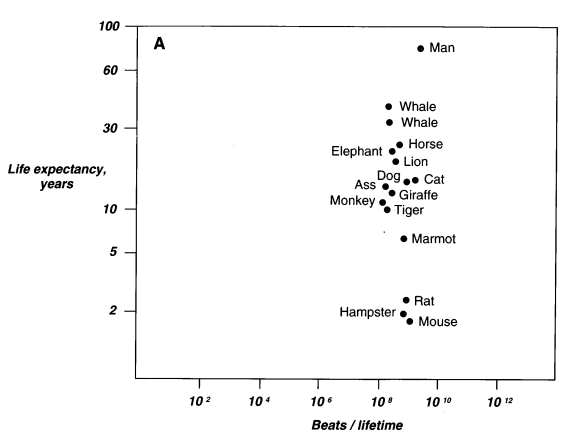
Isn’t that a cool result? All these different mammals have very different heart rates (15 bpm for whale, 600 bpm for mouse) and life expectancies (40 years for whale, 2 years for mouse), yet all have roughly the same amount of total heartbeats throughout their lifetime. If you are a mammal, you get about 10 billion heart beats and that’s it. It’s a better predictor of how much life you get than chronological time. Human is a little bit of an outlier, likely due to modern medicine squeezing out another half-log of heartbeats, but it’s a real finding. Your life is measured in heartbeats, not time. When it comes to life expectancy, the heart is the undisputed MVP organ.

To use an expression I hate, this knowledge lives rent-free in my head. I’ve carried a small but persistent sense of dread that the things I have done throughout my career and as a student have shortened my life. The copious amounts of coffee, red bull and other stimulants I’ve leaned on to power up and manically charge through all obstacles and competition have spent way too many precious heart beats. Additionally, I’ve always had a hunch my heart was naturally too quick. That even without the stimulants, my heart would give out unnaturally early.

So what’s a normal resting rate for a human? For a healthy Brazilian male, (which I am not), it’s 64 beats per minute. (According to the Brazilian Longitudinal Study of Adult Health (Dantas, Milll et al. 2017)

So how low was my resting heart rate at the clinic?

43-48 bpm. I just looked down at the Apple watch I’m borrowing from Claw, 47 bpm as I write. That’s low. So low, the EKG function on the watch doesn’t even work.

I found another source stating that mean resting heart rates are 61.4 with a standard deviation of 3.7. If that’s true it looks like I’m something like 4 standard deviations away from the mean. That’s so much of an outlier, it’s hard to believe.

After talking with the doctor, some things in the past started to click. At an urgent care facility about 10 years ago, they gave me an EKG when I just had a muscle spasm. I thought they were just ruling out a heart attack, even though I was in my thirties at the time and decently healthy.

A few years ago, I had a kidney stone that was broken up with lithotripsy. Afterwards, because the pain was unbelievable, we went to an ER to verify everything was ok (it was, I was just in agony). Claw recently told me that after they hooked me up to the heart monitor, a crowd of nurses and medical personnel gathered around it just to observe and watch my slow heart rate (I was out of it, not paying attention and had no idea).

Since the appointment last week, I have been wearing Claw’s Apple watch because it has heart monitoring functions. The doctor suggested it to gather data. Just checked again. 44 bpm. Fuck me, I have an elephant heart.

So I have a very slow heart. the medical term for it is Bradycardia. In my case it doesn’t seem to be a problem.

There weren’t any clues. I truly had no idea. I’m still having a hard time accepting that it’s unusual. I eat like shit, sugar and junk food binges. I’m kind of athletic, but not really. I try to exercise my way out of a crap diet, living by the terrible motto, “If the fire burns hot enough, you can eat anything”. Even so, I’m definitely not a super athlete or anything. I don’t do any cardio, although I do workout 5 out of 7 days. Nothing nuts, just 30 minutes of not particularly strenuous weightlifting. When I weightlift, my heart has no problem powering up to over 160 bpm.

Anyways, I’m fascinated and weirdly proud of this. I have a lower bpm than an athlete half my age. In the dark part of my mind, I thought I had an abused rabbit heart that was fast wearing out. Instead I’m a sea turtle, very slowly creeping towards the finish line. So much of our life is the product of random uncontrollable circumstances. I’m thankful that of all things to be an extreme outlier on, this is it.

UHC

Yesterday morning, the United Health Care CEO Brian Thompson was shot dead in NYC.

I made a career in pharmaceutical development. Many people get rich in pharma, but at least that industry produces drugs that can save and improve lives. The profit in the system makes drugs more expensive. But it also increases development speed and innovation.

It is much harder to see the value of health insurance. The only way to significantly increase profit for a health insurer is to deny and delay care for people that need it. Their profits are blood money.

UHC is notoriously the worst offender when it comes to denying and delaying health care coverage. If I was making a list of the most evil people in the world, without even knowing who it was, there is a good chance the CEO of UHC would be in the top 100.

A friend of mine sent me an uncensored video of the murder yesterday. The killer looked calm and focused. His gun appeared to jam after the first shot, but he didn’t panic. He just banged the side to unjam, while steadily walking slowly up to his target to finish him off. He never ran, leaving at a slow trot across the street out of camera view. The media is reporting he dropped ammo and wasn’t professional, but I’m not so sure.

It’s almost certain this was a motivated killing. I imagine someone lost someone close to them after an expensive medical battle. UHC probably pulled their usual bullshit, denying coverage at every step. Maybe the family was left with loss, massive debt and incredible rage.

Its also notable that bitcoin is at all-time highs right now. One thing bitcoin is good for is hiring hitmen on the dark web. My guess is some crypto-bro had someone close to him die and decided to spend some of his new found wealth to take retribution.

Stoner Science

I am the most straight edge I’ve been since I was a teenager. Not even caffeine. It has been almost two months (with at worst a few beers and some chocolate).

The past few years I’ve grown weed, ever since recreational use in Massachusetts was legalized. I built a raised bed and hardware cloth enclosure at the back of the property. I framed it well, made it as discrete as possible, built the door and everything. Applied techniques from giant pumpkin growers and had absolute monster plants. More weed than I knew what to do with.

I managed it well, tried to only indulge on Fri and Sat nights. Maintained solid performance in my career. I took it as edibles, pretty gross how I did it actually. Just eating decarboxylated ground flower, rinsing it down with a flavoured drink. The last couple years, making gummies. It was nice to zone out at night. The insidious thing about weed is that you don’t always realize it makes you dumber. I would say if it’s in your system, you are at best 85% of who you usually are. Sometimes this is really nice. Sometimes not ideal. It’s a motivation killer too.

I wanted to understand what went on in the brain of chronic users. It’s interesting (at least to me).

The molecular biology is a bit similar to caffeine. In the brain, neurons have adenosine receptors. When adenosine binds to these receptors, they activate. This creates the signal that we feel sleepy and should rest. Caffeine does a really good job getting into the brain, binding and out competing adenosine for the receptors. The difference is, when caffeine binds it doesn’t activate the receptors, so when we have a cup of coffee the sleepiness signal is blocked. So caffeine is an antagonist. The brain responds by making more receptors, humans drink more coffee to block more receptors and the cycle continues. Then when you quit caffeine it’s miserable because you have a head full of adenosine receptors that you don’t need. You want to sleep all the time, headaches and it takes weeks to reset the brain to baseline receptor levels.

There’s another receptor in the brain called CB1 (Cannabinoid Receptor Type 1). The molecules that bind to it are produced when we have stress, pain and intense neural activity. CB1 receptor signalling likely evolved as a trauma response. When the natural ligands (binders) bind to them, pain sensation decreases, stress and anxiety is reduced, the neurotransmitter glutamate is decreased as you think slower, short-term memory is impaired, and appetite is stimulated. When this natural signalling occurs, it’s your body trying to calm you down during a traumatic or maybe life-threatening event. There’s something beautiful about that – your body trying to help you calm down under conditions that are really, really bad. (just an aside – honeybees gorge themselves on honey when they think the hive is on fire. Increased appetite as a stress response isn’t unique to humans).

So weed (Tetrahydrocannabinol or THC) does a similar thing as caffeine, except it isn’t an antagonist (inhibitor), it’s an agonist (activator). It binds to these CB1 receptors, but instead of blocking the CB1 signaling response, it increases it, to give you a cheat code to that stoned, hungry, slow-brained euphoria. It’s interesting to think of it from the perspective of the neurotransmitter glutamate. Glutamate is your daily “thinking power”. It is limited. Each day you can only expend so much glutamate before your brain slows down. Sleep clears it out and resets our brain to a full tank. Weed inhibits glutamate, and it shows. Stoned people clearly aren’t thinking at 100%.

But what happens over time, with constant use? Just like with caffeine, your brain tries to adapt. It reduces the number of CB1 receptors in your brain. Now THC inhibition of glutamate decreases – your brain is trying to restore your thinking power. Now you need more weed to feel stoned. This is tolerance. CB1 receptors are downregulated.

Now what happens when a heavy user quits weed cold turkey as I did about two months ago? The CB1 receptors are still downregulated but there is no THC in the system, so there is zero inhibition of glutamate. “Thinking power” shoots through the roof and you feel creative and big brained (also more prone to anxiety and restlessness). I felt this too. I’ve never felt more super-charged and big brained than the week after I quit weed. Interesting? No? Well whatever, I’m going to stay straight edge for a while. It feels great.